Showing posts with label Aves. Show all posts

Friday, 19 May 2017

Brainfever bird


A few words: If you've ever been walking through a forest when suddenly, a creepy three-note call carries through the trees again and again until it abruptly stops.  Congratulations! You've just had your first unnerving encounter with the brain-fever bird. Known for its disturbing call, the brain fever bird even looks like a complete wacko, and can be easily identified. All one has to do is look for yellow markings around crazed eyes.


Common name: Common hawk-cuckoo; brain-fever bird

Scientific name: Hierococcyx varius

Scientific classification: Kingdom: Animalia
                                               Phylum: Chordata
                                               Class: Aves
                                               Order: Cuculiformes
                                               Family: Cuculidae
                                               Genus: Hierococcyx
                                               Species: H. varius

Type of species: Indigenous

Distribution: It is found in most parts of the Indian sub-continent. Some birds go as far as Sri Lanka in the winter months.

Habitat: Arable land, tree groves, deciduous and semi-evergreen forests.

Conservation status: Least concern

Sound recording: http://www.xeno-canto.org/369255


Distribution map:
Source: hbw.com

Thursday, 18 May 2017

Common Myna


A few words: Dera doesn't seem to have a very large myna population. However, they can be easily found. They often aggregate in groups on the paths and roads that wind through the forest and farm alike. Perhaps their most noticeable feature is the yellow markings around both eyes. They make for good photography subjects; not shying away from the camera and moving relatively slow.

The IUCN Species Survival Commission has declared mynas to be one of the world's most invasive species. In-fact, it is one of only three birds in the top 100 species that poses a threat to biodiversity, agriculture and human interests.

A perfect specimen


Common name: Common myna

Scientific name: Acridotheres tristis

Scientific classification: Kingdom: Animalia
                                               Phylum: Chordata
                                               Class: Aves
                                               Order: Passeriformes
                                               Family: Sturnidae
                                               Genus: Acridotheres
                                               Species: A. tristis

Type of species: Indigenous

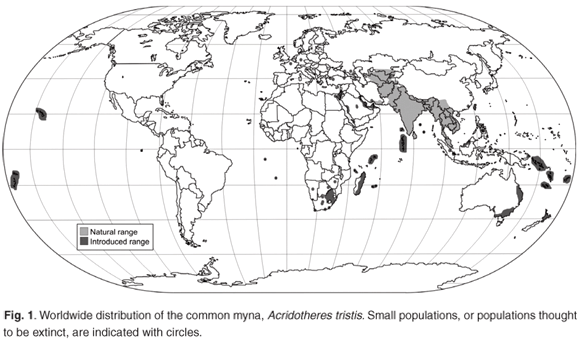
Distribution: Though it is native to Asia, it has been introduced in a large number of countries, from Canada to Australia. This has made the myna a global presence.

Habitat: Open woodland, agricultural regions and areas around human habitation.

Conservation status: Least concern

Sound recording: http://www.xeno-canto.org/364334


Distribution map:

                       
Source: scielo.org.za


Tuesday, 20 December 2016

White rumped munia


Common name: White-rumped munia; white-rumped mannikin.

Scientific name: Lonchura striata

Scientific classification: Kingdom: Animalia
                                             Phylum: Chordata
                                             Class: Aves
                                             Order: Passeriformes
                                             Family: Estrildidae
                                             Genus: Lonchura
                                             Species: L. striata

Type of species: Indigenous

Habitat: Open woodlands, grasslands and scrub forests. It can also adapt to agricultural areas.
 
Conservation status: Least concern

Sound recording: http://www.xeno-canto.org/24614
 
Distribution: The white-rumped munia seems to have originated in India and then spread towards Africa and Pacific Ocean habitats.

Source: hbw


Saturday, 17 December 2016

Loten's sunbird


Male preening himself


In a tree
Keeping a lookout

An awkward moment.

Common name: Loten's sunbird; long-billed sun-bird; maroon-breasted sunbird.

Scientific name: Cinnyris lotenius

Scientific classification: Kingdom: Animalia
                                             Phylum: Chordata
                                             Class: Aves
                                             Order: Passeriformes
                                             Family: Nectariniidae
                                             Genus: Cinnyris
                                             Species: C. lotenius

Type of species: Indigenous

Habitat: Commonly found in forests and cultivated areas.
 
Conservation status: Least concern

Sound recording: http://www.xeno-canto.org/311201
 
Distribution: Found only in peninsular India and Sri Lanka.

Source: hbw


Note: Difference between male and female birds is shown below.

Source: jlrexplore

Asian Koel

Male


Common name: Asian Koel

Scientific name: Eudynamys scolopaceus

Scientific classification: Kingdom: Animalia
                                             Phylum: Chordata
                                             Class: Aves
                                             Order: Cuculiformes
                                             Family: Cuculidae
                                             Genus: Eudynamys
                                             Species: E. scolopaceus

Type of species: Indigenous

Habitat: Found in light woodlands and cultivated areas.

Conservation status: Least concern

Sound recording: http://www.xeno-canto.org/319736
 
Distribution: This bird is found mostly in tropical southern Asia.

Source: wikimedia, (area in black)


Note: Females look different as shown below:

Source: wikimedia

Indian pond heron


Common name: Indian pond heron; paddybird

Scientific name: Ardeola grayii

Scientific classification: Kingdom: Animalia
                                             Phylum: Chordata
                                             Class: Aves
                                             Order: Pelecaniformes
                                             Family: Ardeidae
                                             Genus: Ardeola
                                             Species: A. grayii

Type of species: Indigenous

Habitat: The feeding habitat is marshy wetlands.

Conservation status: Least concern

Sound recording: http://www.xeno-canto.org/116748

Distribution: Widely distributed across India.


Tuesday, 13 December 2016

Tickell's Blue Flycatcher


Male bird

In a tree

Common name: Tickell's blue flycatcher

Scientific name: Cyornis tickelliae

Scientific classification: Kingdom: Animalia
                                             Phylum: Chordata
                                             Class: Aves
                                             Order: Passeriformes
                                             Family: Muscicapidae
                                             Genus: Cyornis
                                             Species: tickelliae

Type of species: Indigenous

Habitat: Dry forest, scrub, bamboo and gardens.

Conservation status: Least concern

Sound recording: http://www.xeno-canto.org/311227

Distribution: Found in India, Nepal and Myanmar.

Source: hbw.com
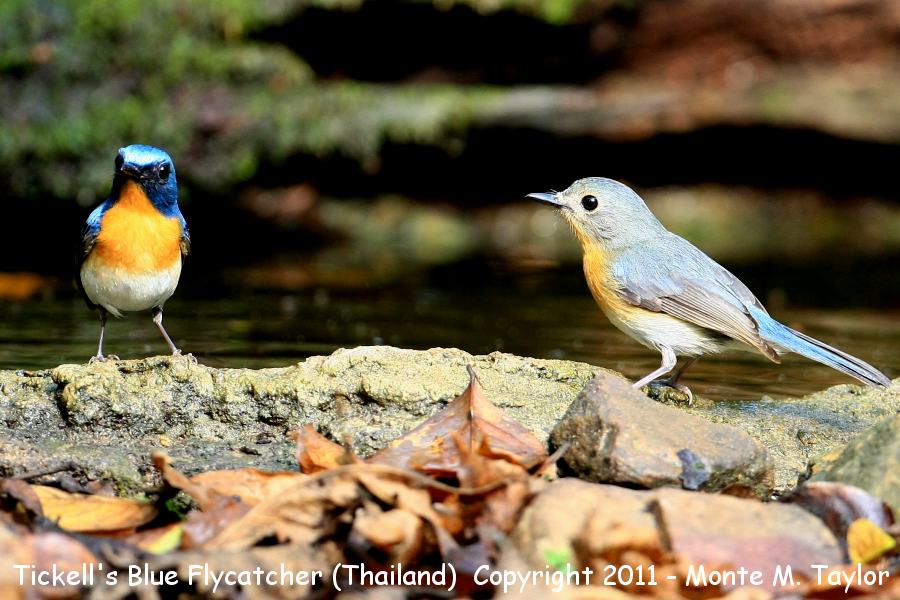
 Note: Difference between the male and female birds shown below.

Source: tsuru-bird.net

Saturday, 10 December 2016

Indian Paradise Flycatcher

Got to be a nominee : 'Best hairdo of the year'
Common name: Indian paradise flycatcher; Asian paradise flycatcher

Scientific name:  Terpsiphone paradisi

Scientific classification: Kingdom: Animalia
                                             Phylum: Chordata
                                             Class: Aves
                                             Order: Passeriformes
                                             Family: Monarchidae
                                             Genus: Terpsiphone
                                             Species: T.paradisi

Type of species: Indigenous

Habitat: They inhabit thick forests and well-wooded habitats.

Conservation status: Least Concern
 
Sound recording: http://www.xeno-canto.org/342232

Distribution: Resident populations in south India and Sri Lanka. These birds are migratory and spend the cold season in tropical Asia.

Source: hbw.com
Note: Pictures sourced from wikipedia.

Male dressed festively for the mating season


Male
Female

Monday, 31 October 2016

Red Vented Bulbul


What d'yu think you're doing?

I spy...

Common name: Red-vented bulbul

Scientific name: Pycnonotus cafer

Scientific classification: Kingdom: Animalia
                                             Phylum: Chordata
                                             Class: Aves
                                             Order: Passeriformes
                                             Family: Pycnonotidae
                                             Genus: Pycnonotus
                                             Species: Cafer

Type of species: Indigenous

Habitat: Dry scrub, open forest, plains, cultivated areas.

Conservation status: Least Concern
 
 Sound recording: http://www.xeno-canto.org/319790

Distribution: Widely distributed in India, this bird is a common sight. It has been introduced in other countries and areas (Hawaii, Fiji, New Zealand).

Source: hbw.com

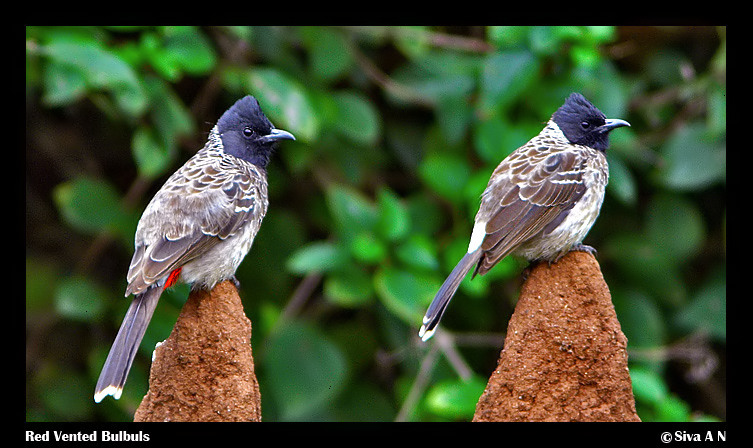
Note: Difference between male and female shown below.

Source: indiannaturewatch

Wednesday, 22 June 2016

Indian Golden Oriole


Common name: Indian golden oriole

Scientific name: Oriolus kundoo

Scientific classification: Kingdom: Animalia
                                             Phylum: Chordata
                                             Class: Aves
                                             Order: Passeriformes
                                             Family: Oriolidae
                                             Genus: Oriolus
                                             Species: O. kundoo

Type of species: Indigenous

Habitat: The Indian golden oriole inhabits a wide range of habitats. These include open deciduous forests, semi-evergreen forests, woodland, forest edge, mangroves, open country with scattered trees, parks, gardens orchards and plantations.

Conservation status: Least concern


Sound recording: http://www.xeno-canto.org/180042
 
Distribution: Found in the Indian sub-continent and Central Asia.

Source: wikipedia
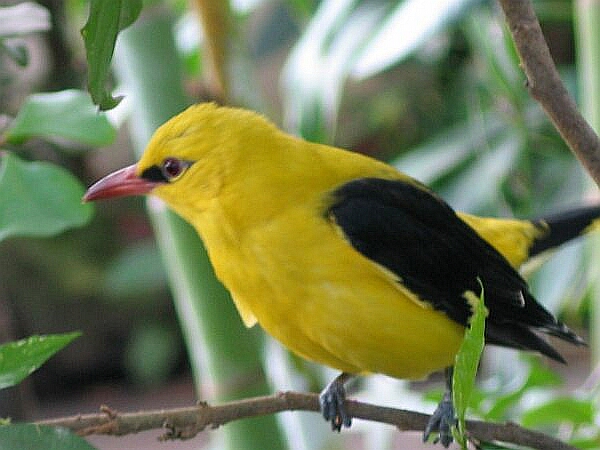
 Note: Not to be confused with the Eurasian Golden Oriole (pictured below).
Source: wikipedia

Saturday, 18 June 2016

Orange-breasted Green Pigeon


Courtesy: Shiva.T
Common name: Orange-breasted green pigeon

Scientific name: Treron bicinctus

Scientific classification: Kingdom: Animalia
                                             Phylum: Chordata
                                             Class: Aves
                                             Order: Columbiformes
                                             Family: Columbidae
                                             Genus: Treron
                                             Species: T. bicinctus

Type of species: Indigenous

Habitat: They live in forests.

Conservation status: Least concern

Sound recording: http://www.xeno-canto.org/311508

Note: Difference between male and female.

Source: orientalbirdimages

Distribution: This species is found only in forested areas south of the lower Himalayas. Seasonally, they can be seen in places like Sind.They are found in Burma, Thailand the Malay Peninsula, Vietnam, Java and Hainan.

source: www.oiseaux.net

Friday, 13 May 2016

House Crow

Common name: House crow; Indian crow; greynecked crow; Ceylon crow; Colombo crow.

Scientific name: Corvus splendens

Scientific classification: Kingdom: Animalia
                                         Phylum: Chordata
                                         Class: Aves
                                         Order: Passeriformes
                                         Family: Corvidae
                                         Genus: Corvus
                                         Species: C. splendens

Type of species: Indigenous
 
Habitat: Ceylon crows thrive in a wide range of environments. They are found in large numbers in various habitats such as cities, forests, deserts, etc.

Conservation status: Least concern

Sound recording: http://www.xeno-canto.org/211561
 
Note: Not to be confused with the Indian jungle crows.

Distribution : The Indian crow is a common bird of Asian origin. It has however, been distributed across the globe by humans' carelessness.

River Kingfisher (A. taprobana)


Common name: River kingfisher; common kingfisher; Eurasian kingfisher

Scientific name: Alcedo atthis

Scientific classification: Kingdom: Animalia
                                         Phylum: Chordata
                                         Class: Aves
                                         Order: Coraciiformes
                                         Family: Alcedinidae
                                         Genus: Alcedo
                                         Species: A. atthis

Type of species: Indigenous

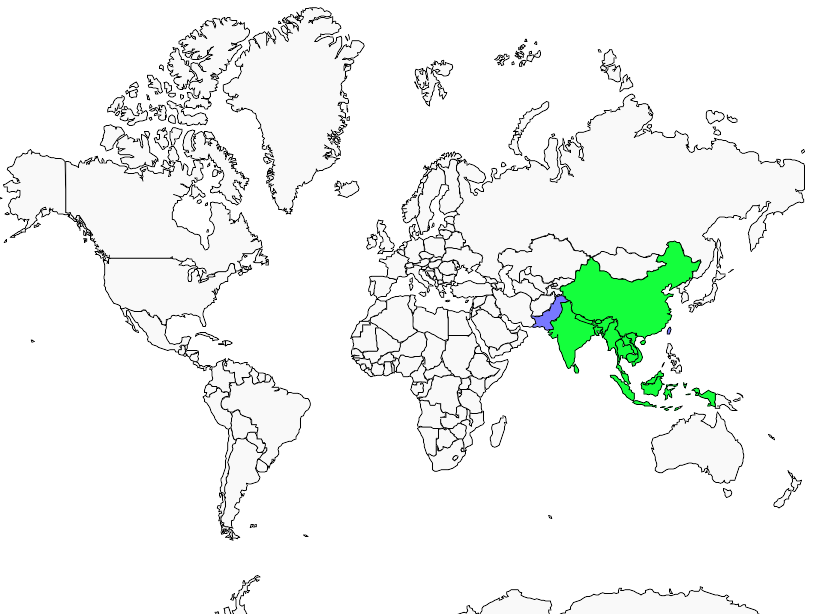
Distribution: The common kingfisher is widely distributed over Europe, Asia, and North Africa, mainly south of 60°N.

Habitat: The Eurasian kingfisher inhabits clear, slow-flowing streams and rivers, and lakes with well-vegetated banks. It prefers scrubs and bushes with overhanging bushes near shallow open water bodies. During the cold season, it becomes more coastal and feeds mainly near estuaries, harbors and rocky sea shores. In India, these birds are present by slow-flowing rivers and streams, mangrove creeks, and swamps.

Conservation status: Least concern

Sound recording: http://www.xeno-canto.org/153401

Distribution map:

Note 1: There are two sub-species of river kingfishers that are found in India(pictured below). One species ( a. taprobana (left)) is native and the other ( a. bengalensis (right)) is migratory.


Source: wikipedia
          
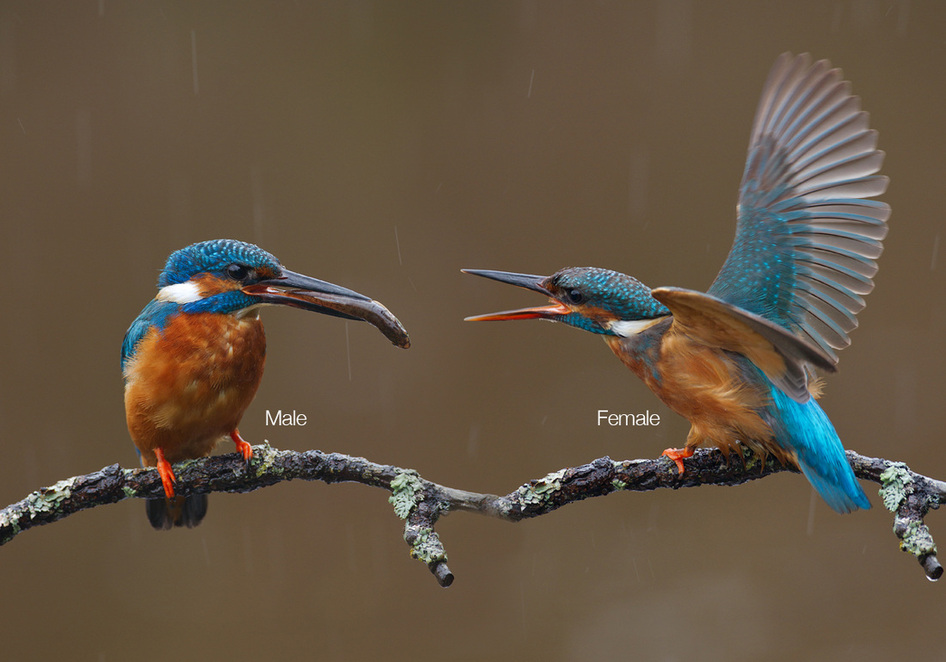
Note 2: Difference between male and female (native).

Source: johnbettsphotography
         

Sunday, 8 May 2016

Indian Jungle Crow

A jungle crow perched on a water dish.
Common name: Indian jungle crow

Scientific name: Corvus culminatus

Scientific classification: Kingdom: Animalia
                                         Phylum: Chordata
                                         Class: Aves
                                         Order: Passeriformes
                                         Family: Corvidae
                                         Genus: Corvus
                                         Species: Culminatus

Type of species: Indigenous

Distribution: This species of Indian fowl is widespread across the mainland south of the foothills of the Himalayas, east of the desert regions of north-western India and having an eastern limit around Bengal. The species is also found in Sri Lanka.

Habitat: Found throughout the region mentioned above.

Conservation status: Least concern

Sound recording: http://www.xeno-canto.org/211568
 
NOTE: This species is not to be confused with the house crow that have a grey neck.

Distribution map:
Source: wikipedia
 

Saturday, 7 May 2016

Indian Peafowl

Peacock visible in the foreground and a peahen in the background.

Common name: Indian peafowl (Males are called peacocks, females are called peahens, offspring are called peachicks)

Scientific name: Pavo Cristatus

Scientific classification:  Kingdom: Animalia
                                          Phylum: Chordata
                                          Class: Aves
                                          Order: Galliformes
                                          Family: Phasianidae
                                          Genus: Pavo
                                          Species: Cristatus
Type of species: Indigenous
Distribution: The Indian Peafowl is occurs in eastern Pakistan through India, south from the Himalayas to Sri Lanka. This bird species is native to India.
Habitat: The Indian Peafowl is a terrestrial bird species found in habitats ranging from open forests to cultivated farmlands.
Conservation status: Least concern

Sound recording: There are a number of calls peafowl use,the most common one is linked : http://www.xeno-canto.org/321544
 

Distribution map:

Source: kids.nationalgeographic.com