Showing posts with label Arthropoda. Show all posts
Sunday, 3 September 2017
Butterfly to be identified
Saturday, 1 July 2017
Mango stem borer
Common name: Mango stem borer
Scientific name: Batocera rufomaculata
Scientific classification: Kingdom: Animalia
Phylum: Arthropoda
Class: Insecta
Order: Coleoptera
Sub-order: Polyphaga
Family: Cerambycidae
Genus: Batocera
Species: B. rufomaculata
Type of species: Indigenous (pest)
Distribution: It is a widely distributed pest. It ranges across China, Israel, India, Jordan, Lebanon, Laos, Mauritius, Malaysia, Madagascar, Myanmar, Puerto Rico, Pakistan, Syria, Sri Lanka, Thailand, Barbados, and the Virgin Islands.
Habitat: Known to affect Ficus carica, Carica papaya, Mangifera indica, and Shorea robusta. Hence, found in habitats that support these tree species, mostly tropics.
Conservation status: Least concern
Saturday, 11 February 2017
Orthomorpha coarctata
| Two millipedes mating. |
| Defense mechanism |
| To scale. |
Scientific name: Orthomorpha coarctata
Scientific classification: Kingdom: Animalia
Phylum: Arthropoda
Class: Diplopoda
Order: Polydesmida
Family: Paradoxosomatidae
Genus: Orthomorpha
Species: O. coarctata
Type of species: Indigenous
Habitat: Found in a wide range of habitats. One such area is semi-forested areas with high levels of humidity.
Conservation status: Least concern
Distribution: This common millipede is purported to be native to Southeast Asia. Unfortunately, due to human carelessness, it has found its way across the world (sub-tropics only).
![]() |
| Source: wikimedia |
Saturday, 17 December 2016
Eudocima homaena
Scientific name: Eudocima homaena
Scientific classification: Kingdom: Animalia
Phylum: Arthropoda
Class: Insecta
Order: Lepidoptera
Family: Noctuidae
Genus: Eudocima
Species: E.homaena
Type of species: Indigenous
Habitat: Found in areas with thick vegetation. Has been found to be a pest w.r.t. orange plants.
Conservation status: Least Concern
Distribution: This moth is found in the Indian subregion, Sri Lanka, Taiwan, Nicobar, Peninsular Malaysia, Borneo, the Philippines, and on Christmas Island.
Note: Many thanks to Nagabhushan Jyothi, a member of India Biodiversity Portal, who identified the species.
Hulodes caranea
Scientific name: Hulodes caranea
Scientific classification: Kingdom: Animalia
Phylum: Arthropoda
Class: Insecta
Order: Lepidoptera
Super-family: Noctuoidea
Family: Erebidae
Tribe: Hulodini
Genus: Hulodes
Species: H. caranea
Type of species: Indigenous
Habitat: Thick vegetation, forested areas.
Conservation status: Least Concern
Distribution: It is found from India, Sri Lanka, Myanmar, Java, Hong Kong to Queensland and New Guinea, it is also found on the Marianas and Carolines.
Note: Thanks to Nuwan Chathuranga from Indian Biodiversity Portal for identifying the moth.
Saturday, 29 October 2016
Oriental Mole Cricket
Common name: Oriental mole cricket
Scientific name: Gryllotalpa orientalis
Scientific classification: Kingdom: Animalia
Phylum: Arthropoda
Class: Insecta
Order: Orthoptera
Sub-order: Ensifera
Family: Gryllotalpidae
Genus: Gryllotalpa
Species: G.orientalis
Type of species: Indigenous
Habitat: These crickets burrow in damp soil creating a network of passages. An oriental mole cricket's natural habitat includes rich soils as well as arable land and gardens.
Conservation status: Least Concern
Sound recording: africana sp.
Distribution: The oriental mole cricket is found in Russia, China, Japan, Taiwan, India, Indonesia, Australia, the Philippines, and Hawaii.
| Source: wikipedia |
Indian Owl Moth
| Beautiful moth |
| A picture at an angle |
| The scale |
Scientific name: Erebus macrops
Scientific classification: Kingdom: Animalia
Phylum: Arthropoda
Class: Insecta
Order: Lepidoptera
Super-family: Noctuoidea
Family: Erebida
Tribe: Erebini
Genus: Erebus
Species: E. macrops
Type of species: Indigenous
Habitat: Found where there are Acacia and Entanada species, which is what they feed on.
Conservation status: Least Concern
Distribution: Found in the sub-tropical regions of Africa and Asia
| Source: wikipedia |
Saturday, 18 June 2016
Common Tiger
![]() |
| Courtesy: Shiva.T |
Scientific name: Danaus plexippus
Scientific classification: Kingdom: Animalia
Phylum: Arthropoda
Class: Insecta
Order: Lepidoptera
Family: Nymphalidae
Genus: Danaus
Species: D. plexipus
Type of species: Indigenous
Distribution: A very wide ranging butterfly, they migrate thousands of miles. They are present in North America and the Caribbean islands.
Habitat: Monarchs require very specific conditions to thrive, given here.
Conservation status: Species of special concern
Interesting fact: Monarchs were taken to the International Space Station and bred there.
Sunday, 15 May 2016
Hersilia savignyi
Common name: Two-tailed spider
Scientific name: Hersilia savignyi
Scientific classification: Kingdom: Animalia
Phylum: Arthropoda
Class: Arachnida
Order: Araneae
Family: Araneomorphae
Genus: Hersiliidae
Species: H.savignyi
Type of species: Indigenous
Habitat: Mostly found living on the trunks of large trees. In this case, the spider lives on one of the cement pillars that hold the roof up.
Conservation status: Least Concern
Distribution: The spider is widely distributed, found in Kerala, Maharashtra, Gujarat, Karnataka, West Bengal, Myanmar, Philippines, Singapore, and Sri Lanka.
Note: Thanks to Anubhav Agarwal of India Biodiversity Portal for For identifying it in part.
Tuesday, 10 May 2016
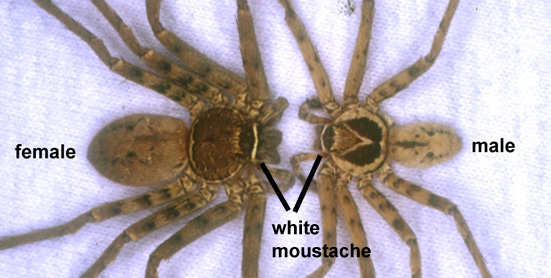
Huntsman Spider
| Heteropoda venatoria on a bathroom wall. |
Common name: Huntsman spider; giant crab spider; cane spider
Scientific name: Heteropoda venatoria
Scientific classification: Kingdom: Animalia
Phylum: Arthropoda
Class: Arachnida
Order: Araneae
Family: Sparassidae
Genus: Heteropoda
Species: H. venatoria
Type of species: Indigenous
Distribution: It is native to the tropical regions of the world, and has been introduced to many subtropical regions.
Habitat: These spiders are common household guests, also found in other buildings such as barns and sheds. They are sensitive to cold and live outside only in warmer climates.
Conservation status: Least concern
Danger warning: These spiders can give a painful bite, though the amount of venom delivered is not dangerous.
Note: Differences between male and female spiders.
| Source: hawaiinaturejournal |
Saturday, 7 May 2016
Crimson Marsh Glider (Male)
| A male crimson marsh glider settled on a reed. |
Common name: Crimson Marsh Glider
Scientific name: Trithemis aurora
Scientific classification: Kingdom: Animalia
Phylum: Arthropoda
Class: Insecta
Order: Odonata
Family: Libellulidae
Genus: Trithemis
Species: Auroro
Type of species: Indigenous
Distribution: Found in the biogeographic region that includes South Asia south of the Himalaya Mountains and Southeast Asia from southern China to Borneo.
Habitat: It can be sighted near small water bodies (streams, ponds, wells, etc.) and marsh areas.
Conservation status: Least concern
NOTE: The male and female crimson marsh gliders are distinctly different in appearance.
Female marsh glider:
| Source: wikipedia |
Subscribe to:
Posts (Atom)